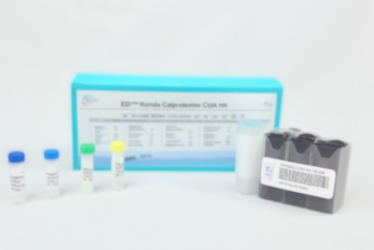
CL0013R

Glial Fibrillary Acidic Protein CLIA kit

Description

This Chemiluminescence Immunoassay (CLIA) kit is intended for the quantitative determination of human glial fibrillary acidic protein levels in serum using the ECL100 or ECL25 Immunoassay analyzer. 

The most abundant type of cell in the central nervous system is an astrocyte, which perform important and complex functions, some of which include participating in synaptic formation and function, maintaining the blood-brain barrier, neurotransmission, angiogenesis, and immune response1,2. When stressed or damaged, astrocytes will undergo activation, and increase the expression of proteins such as glial fibrillary acidic protein (GFAP), which can then serve as a biomarker for neuronal damage3,4,5,6. GFAP is a type III intermediate filament protein, comprised of a head, rod, and tail domain, and has the ability to form coiled-coil dimers with several other intermediate filament proteins, including themselves7. GFAP is important in maintaining the cytoskeletal structure of glial cells, such as astrocytes, and thus, plays a role in the functioning of these cells8. GFAP concentration has been reported to be a potential indicator for several neurological conditions, including traumatic brain injury, Alzheimer’s disease, glioblastoma, and Parkinson's disease. 

For research use only. Not for use in diagnostics procedures.

Background


This CLIA is designed, developed, and produced for the quantitative measurement of human GFAP in serum samples. The assay utilizes a two-site “sandwich” technique with two antibodies that bind to different epitopes of GFAP.

Assay calibrators, controls, or patient samples are added directly to a reaction vessel containing streptavidin coated magnetic particles. Acridinium ester antibody and a biotin antibody are added. The magnetic particles capture the biotin antibody as well as an immunocomplex in the form of “magnetic particles – biotin GFAP antibody –GFAP– acridinium ester GFAP antibody”.

​​​​​​​The materials bound to the solid phase are held in a magnetic field while unbound materials are washed away. Then, the trigger solution is added to the reaction vessel and light generated by the reaction is measured with the ECL100 or ECL25 analyzer. The relative light units (RLU) are proportional to the concentration of GFAPin the sample. The amount of analyte in the sample is determined from a stored, multi-point calibration curve and reported in serum GFAP concentration.

Specifications

Catalog no. CL0013R
Target Glial Fibrillary Acidic Protein
Species Human
Method Sandwich CLIA
Tests Per Kit 100 tests
Detection Flash AE Chemiluminescence
Sensitivity / LLOD 5.37 pg/mL
Dynamic Range 0 - 186.00 pg/mL
Total Incubation Time <40 min
Sample Type Serum
Sample Volume 50 µL
Storage Temperature 2-8 °C

Selected Literature

1. Gradisnik, L., & Velnar, T. (2023). Astrocytes in the central nervous system and their functions in health and disease: A review. World Journal of Clinical Cases, 11(15), 3385–3394. https://doi.org/10.12998/wjcc.v11.i15.3385
2. Luana Heimfarth, Fabiolla Rocha Santos Passos, Brenda Souza Monteiro, Adriano Antunes de Souza Araújo, Lucindo José Quintans Júnior, Jullyana de Souza Siqueira Quintans, Serum glial fibrillary acidic protein is a body fluid biomarker: A valuable prognostic for neurological disease – A systematic review, International Immunopharmacology, Volume 107, 2022, 108624, ISSN 1567-5769, https://doi.org/10.1016/j.intimp.2022.108624. (https://www.sciencedirect.com/science/article/pii/S1567576922001084)
3. Huebschmann, N. A., Luoto, T. M., Karr, J. E., Berghem, K., Blennow, K., Zetterberg, H., Ashton, N. J., Simrén, J., Posti, J. P., Gill, J. M., & Iverson, G. L. (2020). Comparing glial fibrillary acidic protein (GFAP) in serum and plasma following mild traumatic brain injury in older adults. Frontiers in Neurology, 11. https://doi.org/10.3389/fneur.2020.01054
4. Kim KY, Shin KY, Chang K-A. GFAP as a Potential Biomarker for Alzheimer’s Disease: A Systematic Review and Meta-Analysis. Cells. 2023; 12(9):1309. https://doi.org/10.3390/cells12091309
5. Matthew Luebke, Manisha Parulekar, Florian P. Thomas, Fluid biomarkers for the diagnosis of neurodegenerative diseases, Biomarkers in Neuropsychiatry, Volume 8, 2023, 100062, ISSN 2666-1446, https://doi.org/10.1016/j.bionps.2023.100062. (https://www.sciencedirect.com/science/article/pii/S2666144623000023)
6. Ganne A, Balasubramaniam M, Griffin WST, Shmookler Reis RJ, Ayyadevara S. Glial Fibrillary Acidic Protein: A Biomarker and Drug Target for Alzheimer's Disease. Pharmaceutics. 2022 Jun 26;14(7):1354. doi: 10.3390/pharmaceutics14071354. PMID: 35890250; PMCID: PMC9322874.
7. Hol EM, Capetanaki Y. Type III Intermediate Filaments Desmin, Glial Fibrillary Acidic Protein (GFAP), Vimentin, and Peripherin. Cold Spring Harb Perspect Biol. 2017 Dec 1;9(12):a021642. doi: 10.1101/cshperspect.a021642. PMID: 29196434; PMCID: PMC5710105.
​​​​​​​8. Zheng, X., Yang, J., Hou, Y. et al. Prediction of clinical progression in nervous system diseases: plasma glial fibrillary acidic protein (GFAP). Eur J Med Res 29, 51 (2024). https://doi.org/10.1186/s40001-023-01631-4

For research use only. Not for use in diagnostics procedures.
clia-kit-blurred